

 By
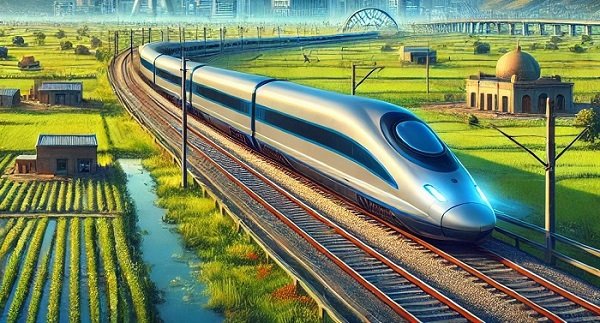
By Pakistan Railways has officially unveiled its ambitious plan to introduce a high-speed bullet train between Karachi and Lahore, aiming to slash travel time from nearly 20 hours to just five. Authorities have set 2030 as the operational target for this transformative project.
The bullet train will be the centerpiece of the $6.8 billion Main Line-1 (ML-1) project, one of the largest and most critical ventures under the China-Pakistan Economic Corridor (CPEC). Covering 1,215 kilometers, the railway line will accommodate trains running at speeds of up to 250 km/h.
Modern Infrastructure Upgrades
The ML-1 project will not only introduce high-speed trains but also revamp the entire railway network with:
- Double tracks for smoother operations
- Reconstructed bridges to ensure safety and durability
- Upgraded signalling systems with modern technology
Key stations along the Karachi–Lahore line will include Hyderabad, Multan, and Sahiwal, making travel convenient for millions of passengers.
Economic and Social Benefits
Railways Minister Hanif Abbasi called the project a “landmark move” for Pakistan’s transport and trade networks. With technical expertise from the China Railway Construction Corporation, the initiative is expected to bring multiple benefits:
- Creation of thousands of jobs during construction and operation
- Increase in rail freight share from 4% to 20% by 2030
- Reduction in road transport dependency, saving billions in fuel imports
- Boost in regional trade and connectivity
Expanding High-Speed Rail in Pakistan
The Karachi–Lahore bullet train isn’t the only development in motion. Earlier this year, Punjab Chief Minister Maryam Nawaz Sharif approved the Lahore–Rawalpindi bullet train, designed to cut travel time between the twin cities to just 2.5 hours.
Together, these initiatives mark one of the most ambitious overhauls of Pakistan’s railway system in decades. If completed as envisioned, the projects could redefine passenger mobility, freight logistics, and economic growth, ushering in a new era of connectivity and modernization.